
Food ordering access
End-to-end accessibility barriers in online food ordering
2025 · 10 weeks · 5 phases
- My role
- Research framing and literature review, interview protocol, moderation of remote sessions, independent transcript analysis, affinity mapping, and lead author on the paper.
- Team
- Four researchers. DePaul University.
- Full work
- Read the full report (opens in a new tab) Read the slide deck (opens in a new tab)
Blind and Low Vision users can place the order. It is the handoff at the door that breaks.
01 Context
Why the whole journey, and not one screen of it
For Blind and Low Vision users, ordering food online is less a convenience than a piece of infrastructure. It removes a trip, a store to walk through, and a stranger to ask for help. The U.S. delivery market is forecast to reach $165 billion by 2029, and BLV users are ordering on the same apps as everyone else.
Accessibility research has covered the pieces. Online shopping. Restaurant menus. Customer reviews. Package pickup. Each study takes one screen and evaluates it. What nobody had looked at was the sequence: browsing, then customizing, then paying, then tracking, then the moment a driver arrives at the door with a bag. That last step has no interface at all, which is why it kept falling outside the literature.
The study asked three questions. What digital barriers show up across browsing, customizing, paying, and tracking? What breaks down during the physical handoff, when the system is a person rather than a screen? And what workarounds have users already built for themselves?
02 Method
Interviews, because the barriers build up over time
A pre-design exploratory study, qualitative by choice. Task-based usability testing would have shown us which buttons are unlabeled on a given day. It would not have shown us what it costs to relearn a payment flow after every update, or what happens when a driver sends a photo instead of a description.
Four BLV adults took part (P1–P4), recruited through the faculty advisor’s accessibility research pool. All were regular screen reader users: VoiceOver on mobile for P1, P2, and P4, JAWS on a Windows laptop for P3. All had used both restaurant and grocery delivery, and all had ordered food online within the previous six months. The sample included both congenital blindness and acquired vision loss.
Sessions ran 45 to 60 minutes over Zoom and covered four areas: background and technology use, digital ordering, real-world delivery coordination, and reflections on independence and coping strategies. Participants received the consent form in advance as both an audio recording and an accessible PDF, and gave verbal consent again at the start of every session. Recordings were stored in a password-protected folder and deleted after transcription.
| Phase | Method | n |
|---|---|---|
| 01 | Literature review and research framing | 16 |
| 02 | Semi-structured protocol design | – |
| 03 | Remote interviews, 45–60 min | 4 |
| 04 | Independent transcript analysis | 4 |
| 05 | Collaborative affinity mapping | – |
Each researcher read the transcripts alone first, writing pain points, behaviors, and quotes onto sticky notes before the group met. Clustering those notes together, rather than coding to a scheme agreed in advance, is what let the patterns cross participants without flattening the differences between them.
03 Evidence
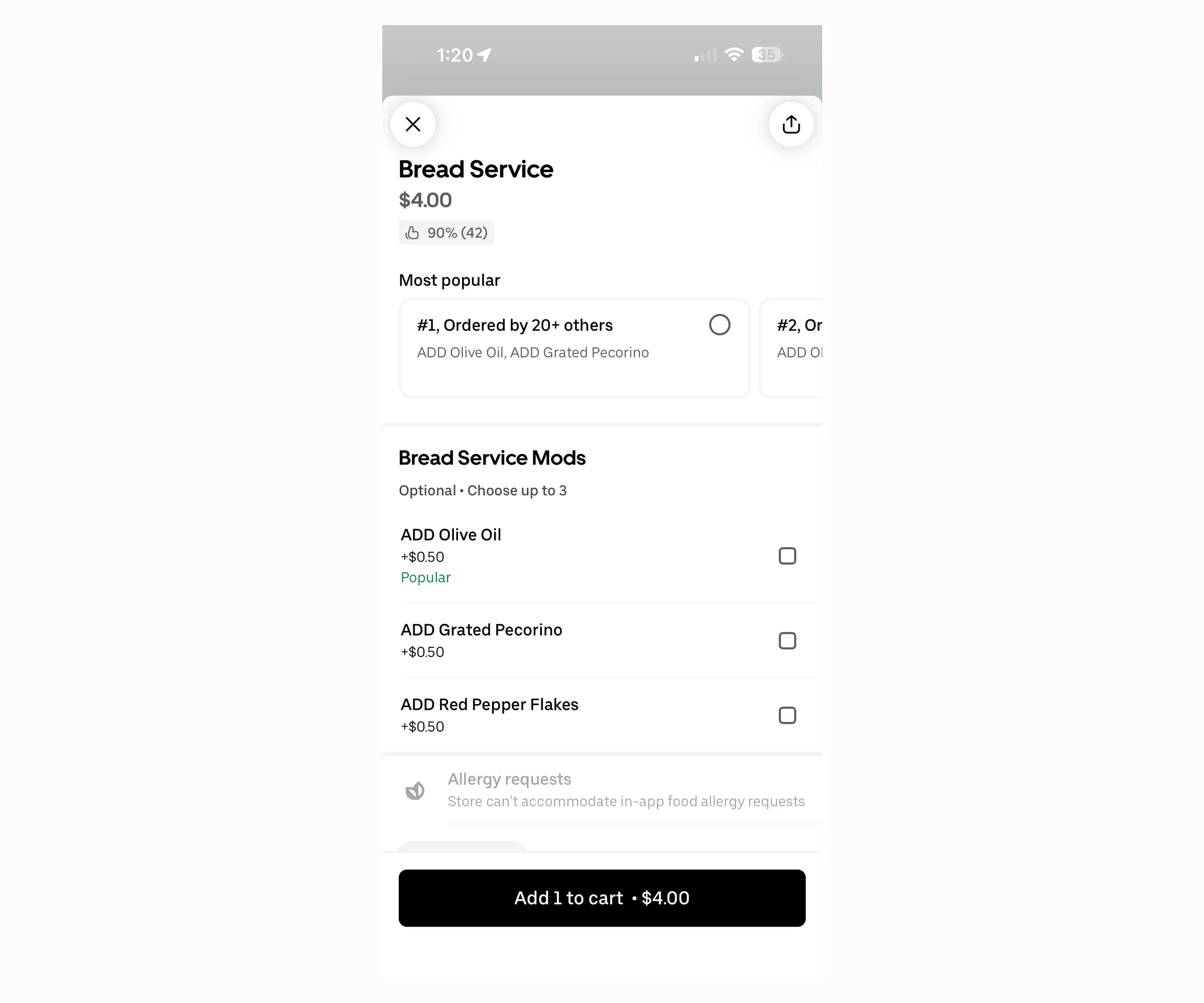
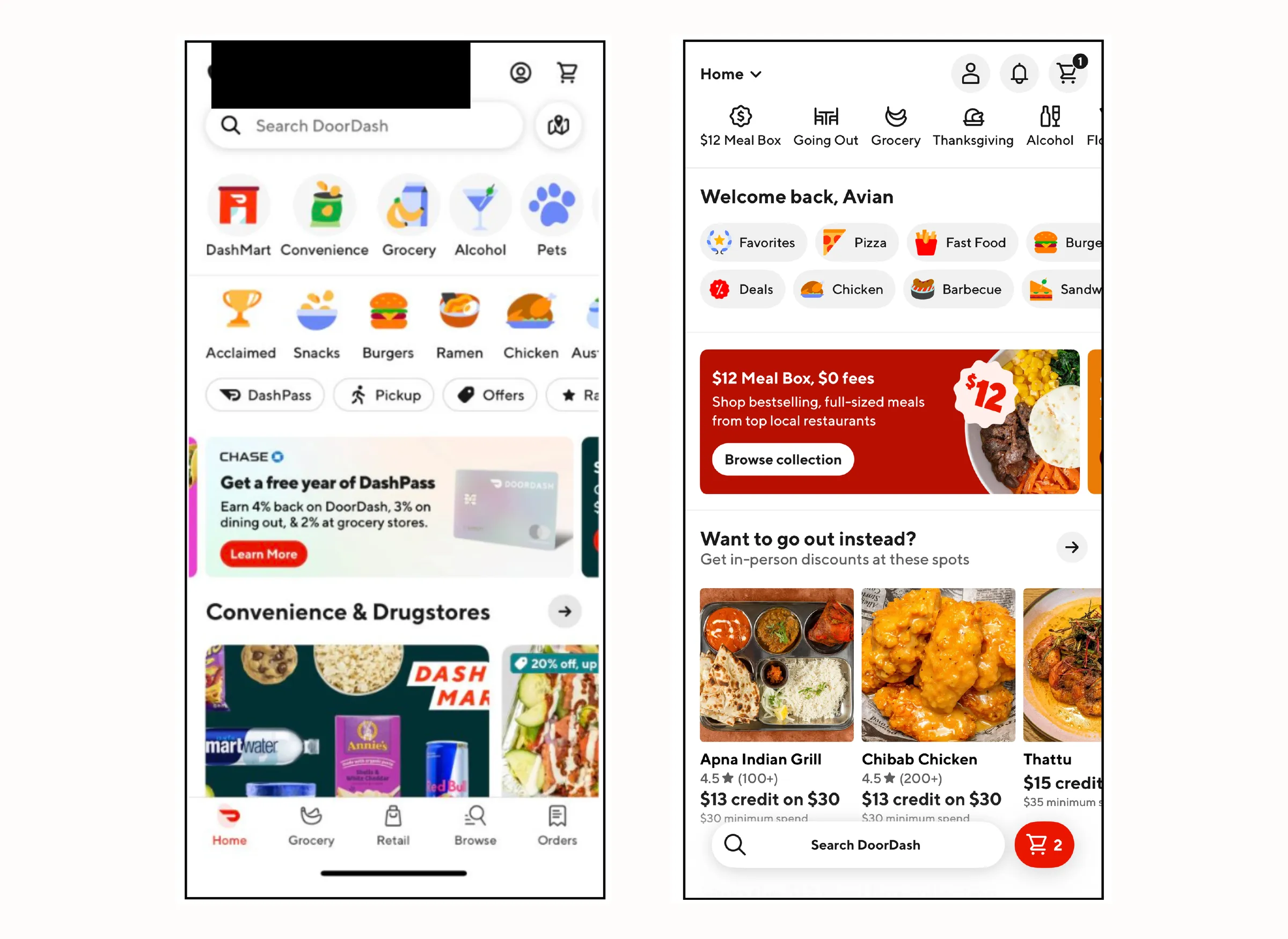
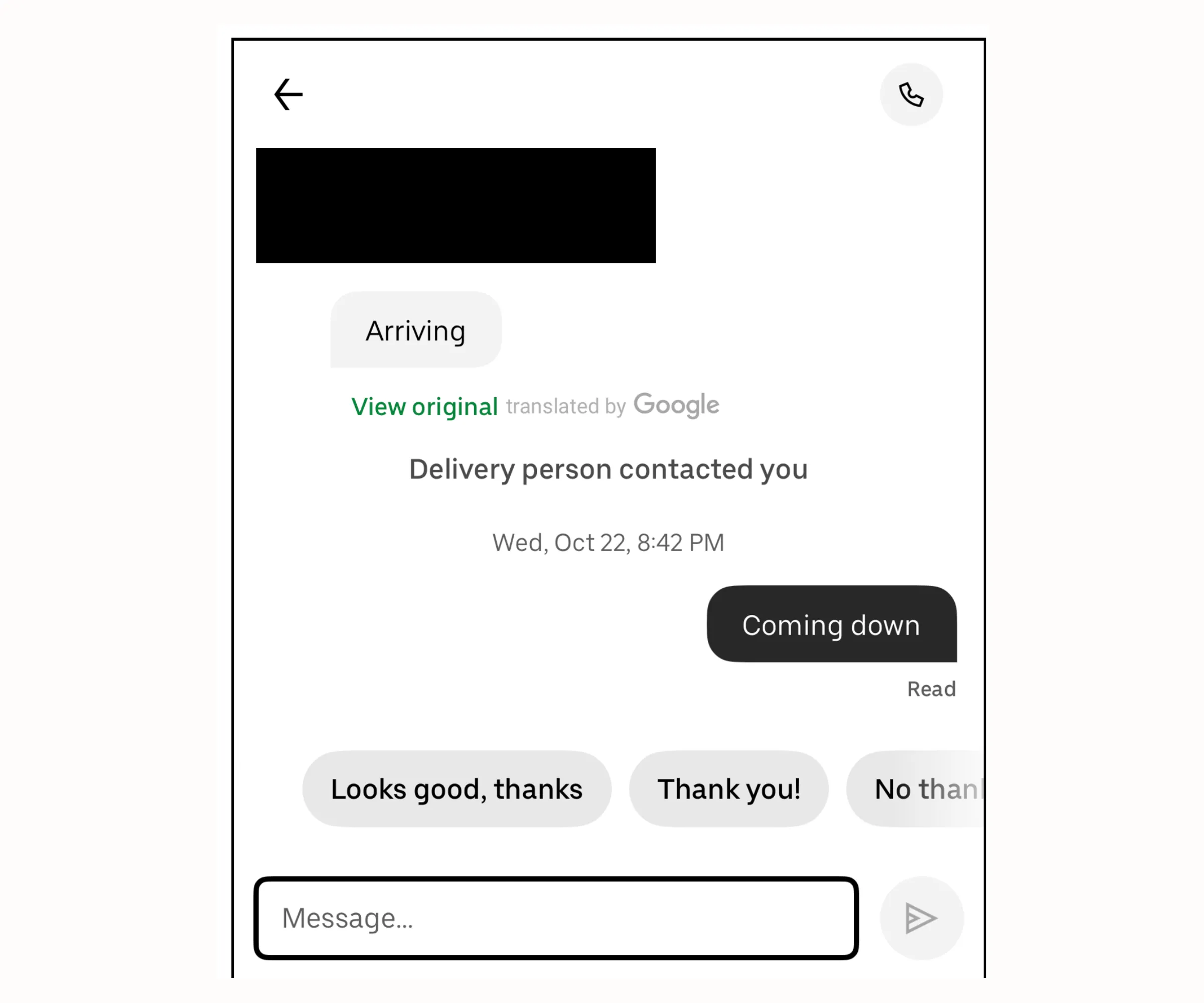
Three screens participants walked us through
04 Synthesis
Four themes from the affinity map
Information gaps. All four participants hit menu items that listed a name and a price and nothing else. P1 wanted “more of a description” before committing to opening each item, and could not confirm whether a restaurant handled gluten-free. For P2, who manages carbohydrate intake with an insulin pump, the missing field was serving size, which turns ordering dinner into arithmetic done on a guess.
That feels like guesstimation, because the restaurants don’t tell you the serving size.
P2, on missing serving sizes
Platform instability. Updates ship and workflows break. P1’s default credit card would “bounce back” to a secondary card after an update, failing payments until it was found and fixed again. P2 found the Instacart cart button unusable, and said updates arrive “without notifying you.” On top of that sits the commercial clutter: promotional pop-ups, sale banners, and sponsored items, all of which have to be passed one at a time. P3, who mainly orders groceries, found sale prices that never reached the final total and had to call support to get receipts corrected.
The handoff. The step with no interface is the step that fails most reliably. Written delivery instructions were followed roughly half the time by P1’s estimate, and “very, very rarely” by P2’s. Drivers sent photographs instead of descriptions. P2 received a picture of a replacement item and had to disclose her blindness to find out what it was. P3 asked a sighted friend to look. Participants had built their own protocols to make up the difference: P2 and P4 text drivers before arrival, and P1 uses text rather than speech when a language barrier makes the phone call unworkable, hoping translation carries the message.
Written → Followed ~50%
Delivery instruction compliance, as estimated by P1
I have to be smarter than that delivery person. And ask them, you know, are they who I think they are?
P1, on verifying who is at the door
And still worth it. Every participant, unprompted, defended these services. P2 called assistive technology a “godsend.” P3 valued not having to travel to a store and find a way around it. P1 valued having “a world of options, at the click of a button.” P4 said the experience made them feel more independent. The barriers are real and the platforms still carry real weight. Both things are true, and a study that reports only the first one misrepresents what these tools are for.
05 Recommendation
What follows for anyone shipping a delivery platform
The barriers add up rather than sit apart. A missing serving size at browse time becomes a phone call at dinner time. An unlabeled cart button after an update becomes a failed payment. A photo sent instead of a sentence becomes a disclosure the user did not choose to make. Accessibility is being treated as a set of separate compliance tasks on individual screens, and it is being lived as one continuous journey that ends with a person standing at a door.
| Principle | Rule |
|---|---|
| Structured item information | Mandatory serving sizes, ingredient lists, and dietary filters. The fields that carry health consequences cannot be optional. |
| Accessibility regression testing | Updates must not break payment selection, cart access, or navigation. Treat a regression here as a broken build, not a cosmetic defect. |
| Reduced commercial clutter | Promotional banners and sponsored items cost screen reader users real time on every pass. Budget them accordingly. |
| Non-visual delivery protocols | Standard text updates, alternate text on any photo the driver sends, and acknowledgement that written instructions were read. |
The clearest limitation is the sample. Four participants is right for exploratory qualitative work and wrong for generalizing. All were U.S.-based screen reader users, so experiences may differ across regions, across other assistive technologies, and across degrees of vision loss. Remote interviews also gave us accounts after the fact rather than observation. We heard about the handoff, we did not watch one.
Three directions follow. Observational or longitudinal methods that catch the end-to-end process as it happens, rather than as it is remembered. A wider participant pool. And platform-by-platform comparison across apps, websites, and phone orders, which would turn “delivery platforms have this problem” into something a specific team can act on.
The work produced a research paper (opens in a new tab) and a slide deck (opens in a new tab).