
Everyday movement
Behavioral design for sedentary daily routines
2024 · 10 weeks · 5 phases
- My role
- Research plan and discussion guide, the daily activity log, two of the ten interviews, thematic analysis, journey mapping, the behavioral archetype, design strategy, and the evening concept with its 3D model.
- Team
- Five researchers. DePaul University.
- Full work
- Read the slide deck (opens in a new tab) View the journey map (opens in a new tab)
Nobody was short of motivation. They were throwing out every movement too small to count as a workout.
01 Context
Why the unit of study is a day, not a workout
Graduate students and young professionals who work at a screen sit for most of their waking hours, and they know it. Nobody in our interviews needed to be told the health case for moving more. Most of them could name the week their last routine fell apart, and what ended it.
So we did not ask how to motivate people to exercise. We asked where sedentary time piles up across an ordinary day, and which of those moments could take on some movement without asking anyone to become a different person.
The literature pointed that way before our data did. Reviews of workplace and university activity programs keep finding that the ones built on structure, accountability and low effort outlast the ones built on motivation and goal-setting. If that holds, movement is better treated as a property of a routine than as a decision somebody makes every morning.
Two groups were in scope: college and graduate students first, full-time professionals in screen-based jobs second. All aged 18 to 30, all sitting six or more hours a day.
02 Method
Two instruments, because one of them lies
Ten semi-structured interviews ran over Zoom at 45 to 60 minutes each. They covered weekday routines, the long sitting stretches, past attempts at a routine and what ended them, and the influence of weather, space and other people. I wrote the research plan and the discussion guide, and each of the five of us moderated two sessions.
Interviews are good at why movement breaks down. They are bad at when and where, because people build a typical day out of the days they are proudest of. So everyone also filled in a daily activity log for three consecutive days.
| Phase | Method | n |
|---|---|---|
| 01 | Semi-structured remote interviews, 45 to 60 min | 10 |
| 02 | Daily activity logs, three consecutive days each | 10 |
The log is the piece I built. It runs on AEIOU, meaning activities, environments, interactions, objects and users, with three fields the framework does not carry on its own: estimated screen time, estimated sleep, and mood. Participants filled it at the end of each day instead of in the moment, which costs precision and buys the chance that anyone finishes it at all.
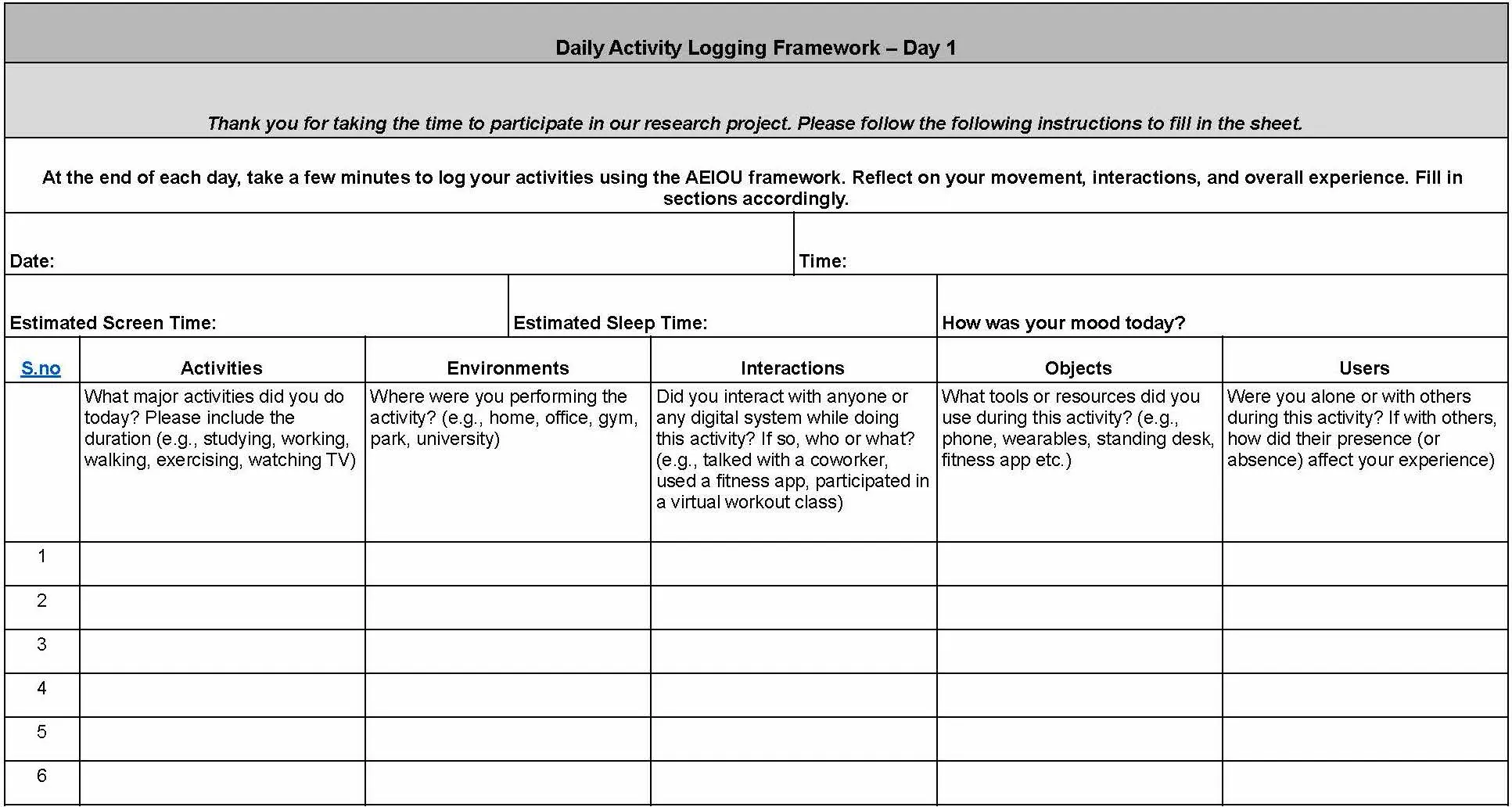
The two instruments disagreed in a useful way. In the interviews, movement failed because of time and motivation. In the logs, the sitting piled into two blocks nobody had raised as a problem: the first half hour after waking, spent on the phone, and the stretch from getting home to going to bed.
03 Synthesis
Four themes, one day, and a change of mind about the cause
Transcripts and logs were coded together, and four themes held across both.
Routines break on inconsistency more than on intent. People described routines that worked, sometimes for months, and ended at a schedule change, not at a loss of interest. Short activity gets counted as self-care instead of exercise, and remembered that way. Accountability takes the daily negotiation off the table, which is why scheduled and social activities outlive solo ones. And the environment sets the ceiling on all of it: a Chicago winter can end a walking habit that had nothing else wrong with it.
When the weather is nice, I love going for walks. But in the winter, it’s so hard to stay consistent.
Interview participant
I’m way more likely to show up when I know my friends are expecting me.
Interview participant
That last theme forced a revision we had not planned for. We opened the study with three hypotheses, and the first one treated individual motivation as the variable to move. By the end of coding, motivation was the one thing every participant already had.
Motivation → Environment
Where the study located the cause of inactivity, before fieldwork and after
The behavioral archetype we built from the coded data is where this reads most clearly. Its mental models each make sense on their own terms and produce a sedentary day anyway. The second one is what the rest of the project turns on.
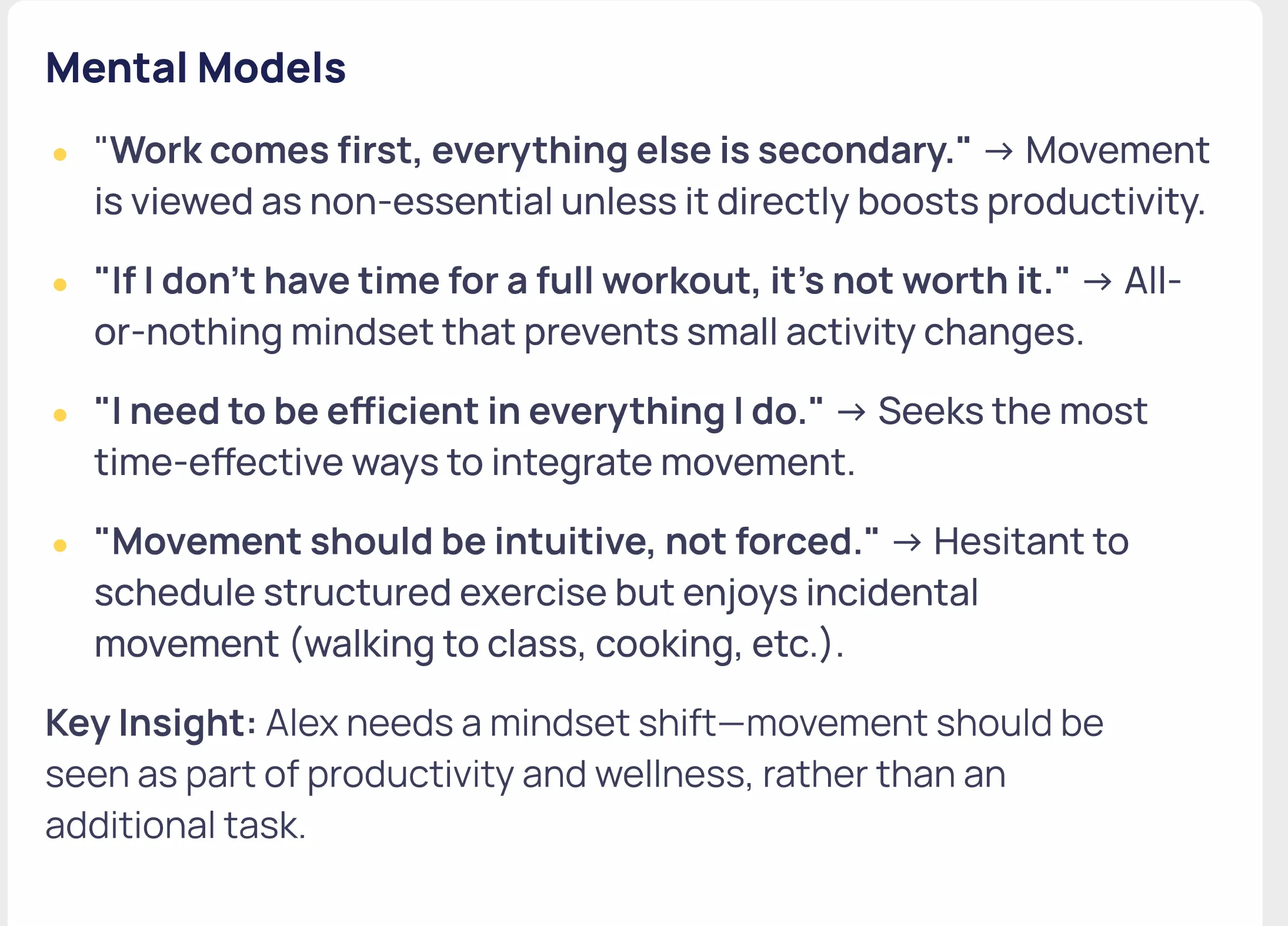
An all-or-nothing rule is enough on its own to keep a motivated person in a chair. If the only movement that counts is a full workout, then a five-minute stretch, a walk to the next bus stop and standing up between episodes are all worth zero, and an ordinary day is made almost entirely of those.
We then laid the whole day out as a journey map: six stages from waking to sleep, banded by sentiment, with actors, barriers, drivers, social norms, opportunity areas and decision levers stacked under each stage. The bottom two rows are the reason it was worth building. They turn a description of the day into something you can read a decision off.
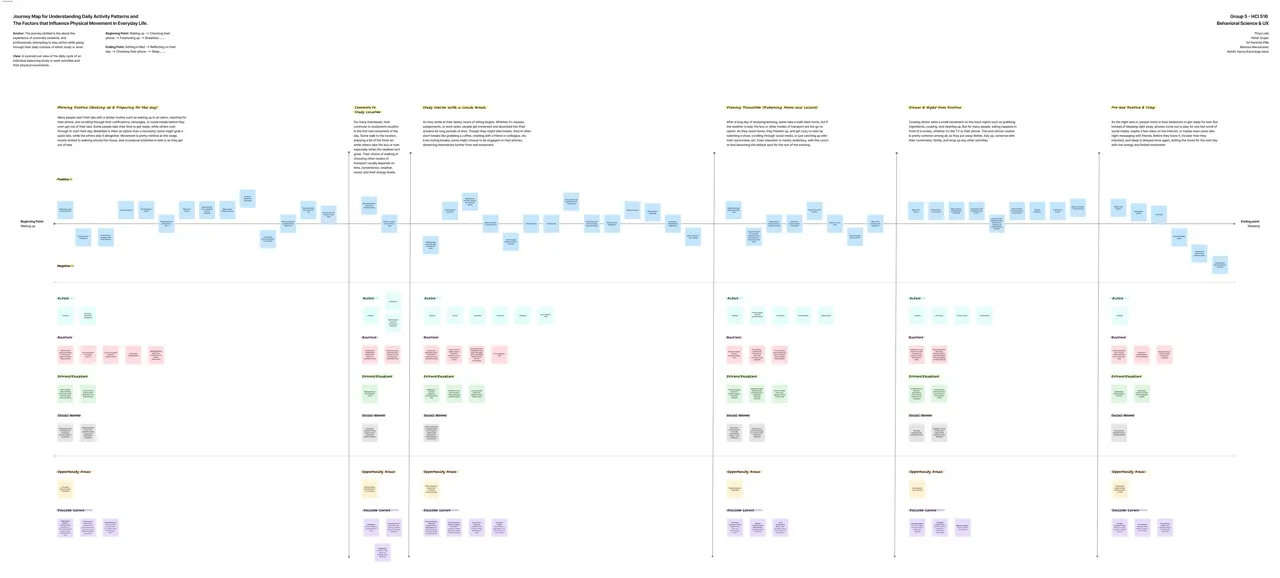
Read left to right, the shape of the day is hard to miss. Sentiment stays flat, and the notes are sedentary at every stage except the commute, which is the one place movement happens without anybody choosing it. Two stages had the most barriers and the least movement already in them: the morning routine and the evening transition.
04 Concepts
Two stages, picked for opposite reasons
We scored all six stages on desirability, feasibility and viability. Morning and evening came out on top, and since they got there for opposite reasons we carried both forward instead of picking one.
Mornings are malleable. The routine is already structured, new habits can be stacked onto it, and participants said outright that they want to start the day well. Evenings are the opposite. It is the most sedentary block of the day, and anything that arrives sounding like an instruction gets rejected, because the point of the evening is to stop being instructed. One concept ended up digital and the other spatial.
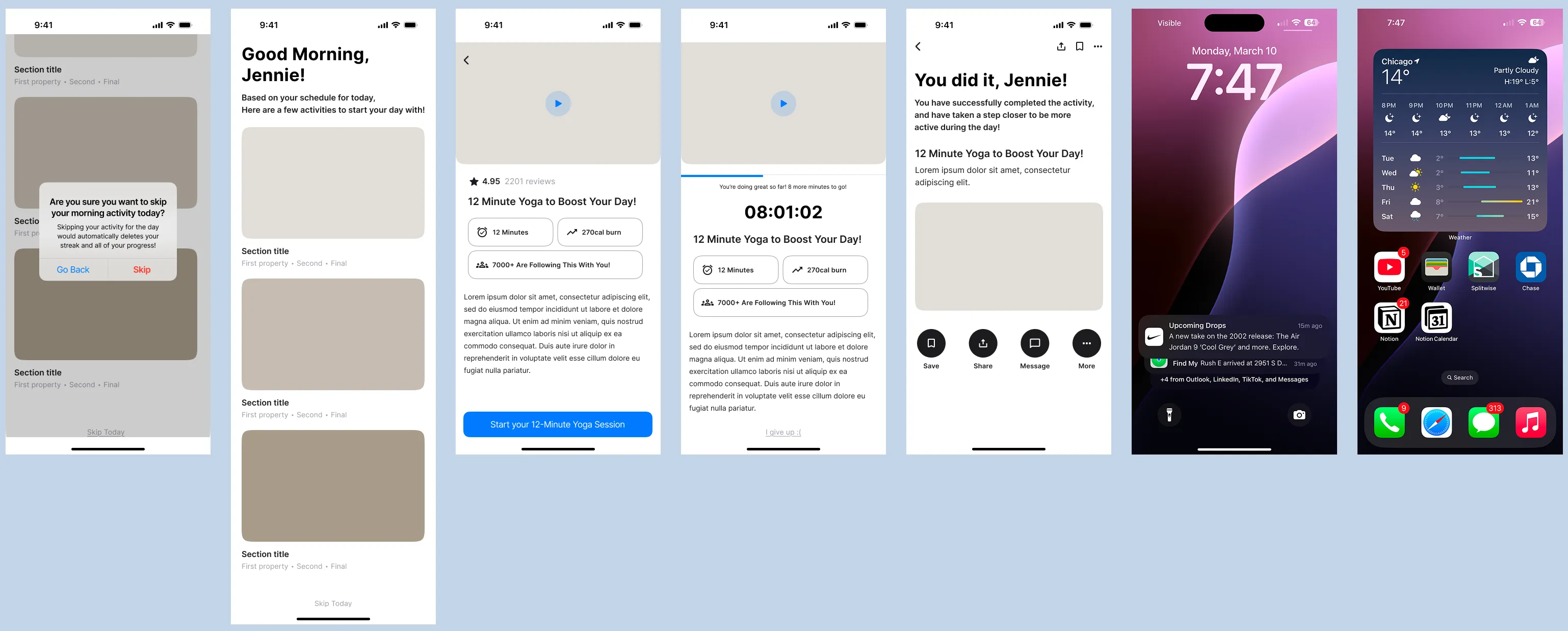
The morning concept is a companion app that reads the clock and the calendar, then offers two or three movement options sized to the time actually available, each showing its duration, a calorie estimate, and how many other people did it today. A countdown runs the session. Leaving early raises a prompt instead of a block. Finishing updates a streak. Opt into a challenge and the movement has to happen before the phone will open anything else, which puts it directly in front of the behavior the logs found.
The evening concept adds no app at all. It moves the television remote. Instead of one remote within arm’s reach, control splits across three placed around the room, one function each, none closer than four metres to another, and movable twice a month at most. Carrying on watching means standing up. After a long sitting stretch an on-screen prompt appears, and if it is ignored the volume fades over thirty seconds, restorable only at the volume remote. An optional version pauses playback unless the phone is sitting in a spot across the room.
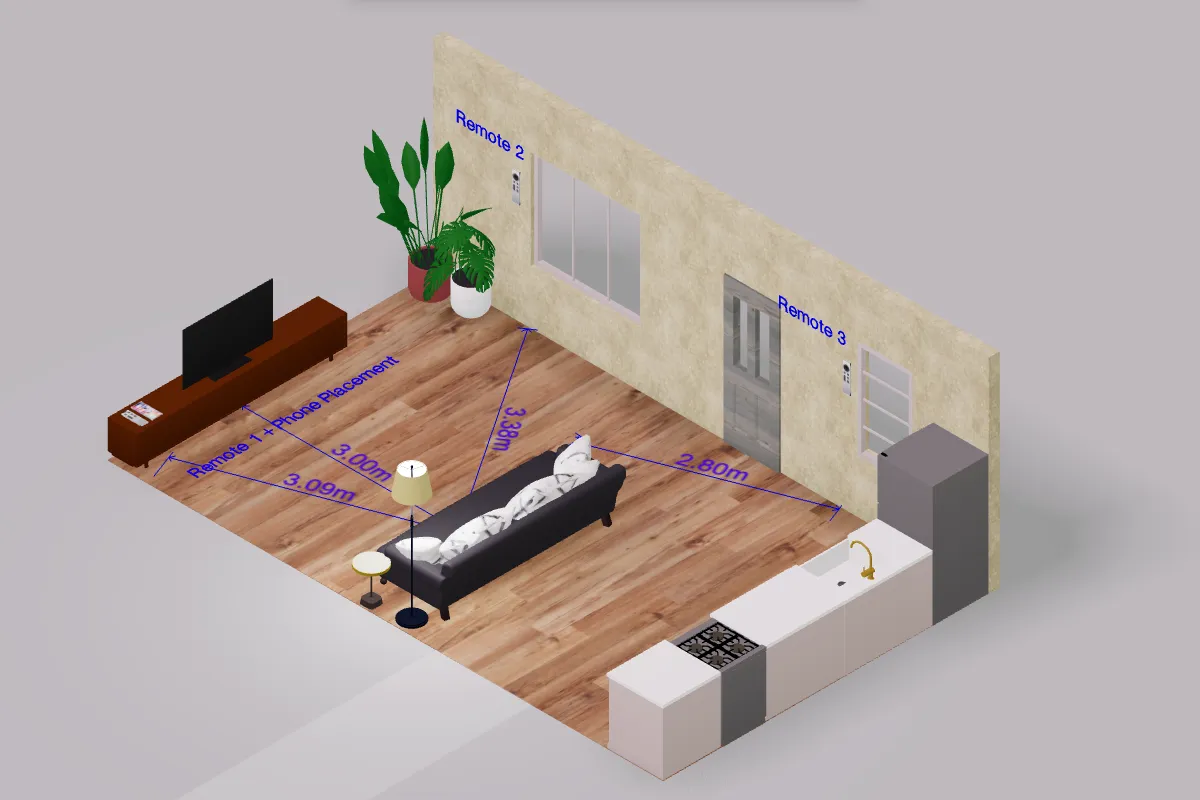
It is the more aggressive of the two, and it took the hardest pushback in critique. The notes were consistent. Give people grace periods and adjustable difficulty, vary the prompts so they do not turn into notification noise, let the intensity be opted into instead of imposed, and account for anybody whose apartment is not four metres wide. The first three are tuning. The last one is a real limit on the idea.
05 Recommendation
What transfers, and what was never tested
The part of this worth taking somewhere else is the rule behind both concepts. If an all-or-nothing belief is what produces the sitting, then anything that asks for a decision will keep losing to that belief, while anything that changes what the easiest next action is never has to argue with it at all.
| Principle | Rule |
|---|---|
| Habit stacking | Anchor movement to something that already happens unprompted. Waking, making coffee, starting an episode. Not to a new slot in the calendar. |
| Choice architecture | Make movement the easiest way to carry on with what somebody is already doing, instead of an alternative to it. |
| Commitment devices | Streaks, fixed times and other people hold follow-through together when motivation is flat. Pair every one of them with a grace period. |
| Environmental nudges | Change the room, the object and the sound before changing the reminder. A prompt can be dismissed. A remote across the room cannot. |
None of this was evaluated, and that is the limit to hold onto. Both concepts are documented directions backed by a slide deck (opens in a new tab) and a full-day journey map (opens in a new tab), and neither has spent a week in front of a real person. That matters more here than it would elsewhere, because the whole mechanism is friction, and friction has a half-life. A volume fade that reads as clever on day one reads as a broken television on day thirty, and nothing in a ten-week study tells you which.
The logs are the second limit. Self-report at the end of a day is good enough to say where the sitting clusters and not good enough to say how much of it there is. Running the logs alongside passive sensing from a phone or a wearable would settle that, and would also test whether the clusters we found are real or just what people remember at bedtime.
If I picked this up again I would start in three places. Run the morning concept with five to ten people for two weeks and measure tolerance instead of completion, since the failure worth catching is annoyance and not skipping. Build the evening concept for a small apartment before a large one, because the layout is where it breaks first. And test whether the all-or-nothing belief moves at all, because every rule in that table assumes it can only be worked around, and a study that shifted it would be worth more than both concepts put together.